
"Dreams, Drive and Da Vinci"
My review of 'Broke & Fabulous in the 21st Century', a play by Dale Robertson
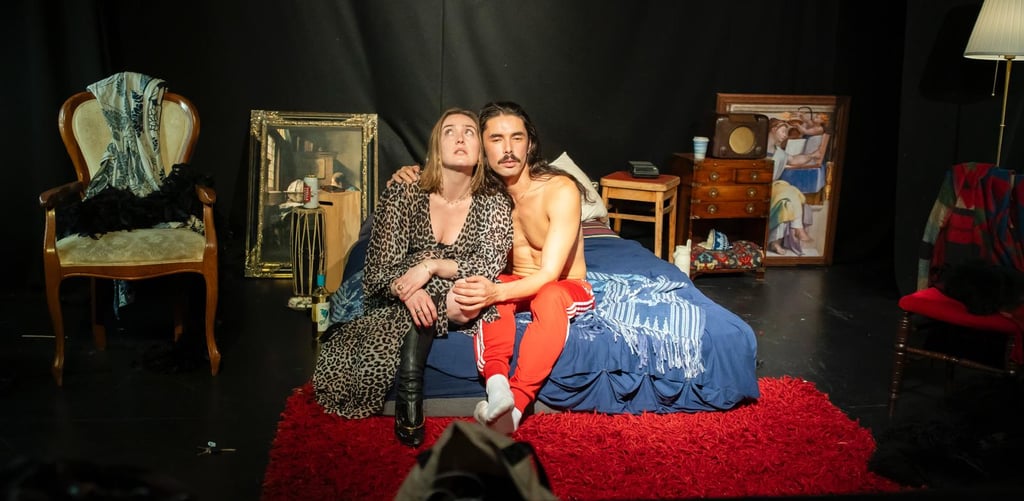
Broke & Fabulous in the 21st Century, written by and starring Dale Robertson, is pitched as an unabashed dramedy for today’s generation. In practice, it’s exactly that – a gorgeously camp, emotionally astute, and painfully recognisable snapshot of messy 30-something life where dreams, desire, and denial all end up sharing one cramped bedroom.
Set entirely in Alex’s room – a makeshift guardianship in an abandoned theatre he’s filled with personality and pizazz – the play centres on three characters: Alex (Dale Robertson), his best friend Petunia (Olive McHugh), and the man they are both, unbeknownst to them, dating: Tom to Alex, Jake to Petunia (Rowland Stirling). Alex and Petunia are two best friends in their chaotic 30s, chasing their dreams and navigating love with all the confusion and bravado of people who should probably know better by now, but very clearly do not.
The spine of the plot is deceptively simple: Alex is casually sleeping with Tom, a charming, emotionally evasive man with whom he has agreed to keep things light, even as their situationship edges into “so… what are we?” territory. Petunia is in a long-term relationship with Jake, a man she loves desperately but feels she is somehow not “enough” for – not sexy enough, not desirable enough, not whatever fantasy she thinks he’s chasing.
Of course, Tom and Jake are the same man.
To the eagle-eyed (or honestly, even the mildly awake), the twist is telegraphed from early on. Each time Alex and Petunia go to show each other their respective mystery men, something gets in the way. Alex only has photos of Tom’s torso from the dating app they matched on. Petunia’s phone dies every time she tries to present photographic evidence of Jake. On the closest call, she falls asleep while it charges and has to sprint off to work before Alex can so much as glance at the screen.
But it would be obtuse to treat this as failed surprise. The play does not seem especially interested in shocking the audience with a big reveal. Instead, by presenting the possibility early on that Tom and Jake are one and the same, Robertson invites us into a shared conspiracy: we watch with growing fascination as these two friends describe the same man completely differently, projecting their needs, fears, and fantasies onto him. The dramatic irony becomes the point; we are not waiting to see what is true, but rather what they will do when the truth finally lands.
Alex: Our safe space, struggling artist, and emotional anchor
Alex’s bedroom is the set, but it is also the emotional landscape of the play. He is broke, earnest, and clinging tightly to his dream of making it on the big stage. Financially, he’s struggling. Emotionally, he’s become a safe harbour – not just for Petunia, but, unbeknownst to him, for Tom/Jake as well.
Alex is both the still point and the sponge. Petunia crashes there whenever she runs from home mid-argument. Tom/Jake uses it as a place where he can play at being another version of himself, away from the pressure of his life as respectable boyfriend and corporate man. Alex gives them both something they do not seem able to give each other: an emotionally safe space to be messily, selfishly themselves.
Deep down, Alex wants to love and be loved, but his history has rendered him jaded about serious dating. He has, by necessity, opted for sexual connections over emotional entanglements. Tom destabilises that defensive philosophy; when Alex speaks about him, there is a light in his eyes that we otherwise only see when he talks about his dreams of the big stage. For a man who insists on staying romantically untethered lest a relationship “derail” his creative trajectory, his belief system is clearly under strain.
Petunia, our baby with a bottle and a bruised heart
Petunia comes from money and chaos in equal measure. She is a self-professed mess – perpetually oscillating between vulnerability and entitlement, fragility and bravado. She loves Jake fiercely but is haunted by the idea that she is not good enough or sexy enough for him. Her response is textbook self-sabotage: binge drinking, storming out of arguments, running away from home, and seeking refuge in Alex’s room and arms (platonically, at least).
One of the standout sequences sees Petunia arrive at Alex’s place drunk, clutching a bag of assorted alcoholic beverages, having just fled Jake’s house after yet another dispute. Hungry, she mistakenly consumes a large dose of Alex’s weed edibles. This is especially funny, and painful, because we already know weed does not agree with her at all – and because the edibles are very expensive and Alex is barely making ends meet. In classic Alex fashion, he responds not with justified rage but with weary grace, even as she literally eats his coping mechanism.
The comedy escalates as both substances take hold. It also leads to one of the play’s most introspective, disarming beats: Petunia finally admits that she is not truly happy, but nevertheless clings to the idea that Jake is “a good guy” and that perhaps she is the problem. For anyone in the audience who has ever held onto a relationship harder than they’ve held onto themselves, her spiral feels uncomfortably, almost tenderly familiar.
Petunia has some of the sharpest, filthiest lines of the night. “Eating me out right now would be like sipping nectar from a frangipani in Jo Malone’s fucking garden!” she declares at one point – an image so indulgently specific it feels like it should come with a scented candle. In another favourite exchange, she announces, “I’m 33,” to which Alex replies, “Well, so was Jesus.” “When he died,” she shoots back. “Touché.” A few lines later, she brands him “the literal son of God – the ultimate nepo baby,” a joke made even funnier by Petunia’s own nepo baby status.
She is jarring, entitled, fragile, and very human. Difficult to judge, especially for those in the crowd who know the quiet ache of wanting to be seen as “enough.”
Tom or Jake? The pressures of the "perfect" life
Tom/Jake is perhaps the least present character physically, but structurally he is the axis around which everything spins. As Tom, he enjoys his time with Alex but refuses to entertain any “next steps” that might force him to confront his bisexuality. As Jake, he presents as the perfect family man: well-paid corporate job, the nice home, the long-term girlfriend, the respectable life trajectory.
In a revealing monologue to Alex, he confesses the pressure he feels to keep all of this in place. Would he really give up the income, the security, the image, for the uncertain possibility of a different life? His answer, in action if not in words, is no. He balances the affair and the relationship, unwilling to lose either, unwilling to commit to either fully.
Tellingly, when Alex and Tom/Jake try to make plans, we discover where his true priority lies. Before agreeing to see Alex, he calls Petunia to check whether she will be home later. Petunia’s schedule controls his availability to Alex – a quiet but significant detail in the staging of his divided loyalties.
By the time the final scene arrives – Tom/Jake stepping into Alex’s room only to be greeted by a stunned Petunia – the dramatic collision feels inevitable rather than explosive. The shock is not in the reveal itself, but in the recognition that, in a world of situationships, blurred lines, and quietly closeted lives, this sort of dynamic is not exceptional at all. It is depressingly standard.
Dating in the era of blurred lines
This is where Broke & Fabulous in the 21st Century gains much of its bite. The play does not treat Tom/Jake’s duplicity as some grand gothic betrayal; instead it frames it as a reflection of a dating culture that has normalised ambiguity, half-truths, and parallel lives. Everyone is, in some sense, lying – to each other, and more importantly, to themselves.
Petunia cannot confront herself without a drink in her hand. Alex hides behind a posture of hyper-independence and sexual nonchalance. Tom/Jake hides behind heterosexual respectability. All three are, in different ways, dodging authenticity. The play is less concerned with condemning them than with holding up a mirror to the messy compromises people make when fear and desire are equally loud.
There is tenderness in this critique. The audience is invited to laugh at the absurdity of it all, but also to recognise how easy it is to end up exactly where these characters are: failing to choose, failing to be honest, stuck between what feels safe and what feels true.
Camp, carnal with killer one-liners
Tonally, the production is a riot. It is gloriously queer, bold and unafraid of sex – in language, in staging, and in implication. The sexting, the references to hookups, the raunchy scenes of intimacy between Alex and Tom are frank and funny, walking a finely calibrated line between raw conviction and outright farce. They never tip into the explicitly pornographic; instead, they mine the inherent beauty of bodies, the dynamics of desire, and the chemistry between actors Dale and Rowland.
The dialogue is sharp and densely packed with punchlines – almost every joke lands, and the emotional beats earn their silence. A standout line from Alex: “When I’m hungry, I go to the National Gallery and look at still lifes.” It’s throwaway, but it also neatly captures his tendency to intellectualise longing, to try and sate real hunger with aesthetic substitutes.
The title of this review, “Dreams, Drive and Da Vinci,” nods to another deliciously camp line from the play: “Dreams, drive and Da Vinci, honey – it’s all carb free!” It encapsulates the play’s worldview: ambition as lifestyle brand, art as identity, and the constant, faintly ridiculous attempt to aestheticise struggle.
Staging, sound, and the use of space
Though the show is intimate in scale, the production design is smart and purposeful. The single-room set is cluttered yet coherent, reflecting Alex’s personality as he tries to create warmth and stability in a precarious living situation. The use of sound design, particularly the recurring daily newscast on the radio, subtly marks the passage of time while also giving us a window into Alex’s routine. We literally watch him cleaning – often after Petunia’s mess – giving her emotional and physical space to frantically pace and unravel while he quietly restores order.
It is a simple motif, but a powerful one: Alex as the one who cleans up and holds space while others spin out. The staging underscores what the script suggests – that the emotional “guardianship” he offers is as real and labour-intensive as the physical one.
Performances and final impressions
Olive McHugh is a standout as Petunia, bringing the audience with her on every dizzy emotional pivot. She manages to make a character who is frequently chaotic, drunk, and self-sabotaging not only watchable but deeply sympathetic. Her Petunia is jarring and entitled, yes, but also raw, vulnerable and painfully relatable.
Dale Robertson’s Alex is all heart and quiet ache, his easy charm and sharp wit masking a deep weariness and a longing he refuses to fully name. Rowland Stirling gives Tom/Jake enough warmth that we understand why both Alex and Petunia are drawn to him, while also retaining the emotional slipperiness that keeps him from ever feeling fully safe or pinned down.
Ultimately, Broke & Fabulous in the 21st Century is less a story about a shocking twist than an honest portrait of three people trying – and largely failing – to live authentically in a world that encourages performance over truth. As well put by Stage Manager Zor Khare, the play is queer, bold and relatable; a show that feels real and unapologetic, that brings both laughter and contemplation in equal measure.
In a culture of ghosting, situationships and curated selves, this play suggests that sometimes the most radical thing you can do is stop running, tell the truth, and sit in the mess. Until then, there will always be an Alex – broke, fabulous, and quietly sweeping up after everyone else.
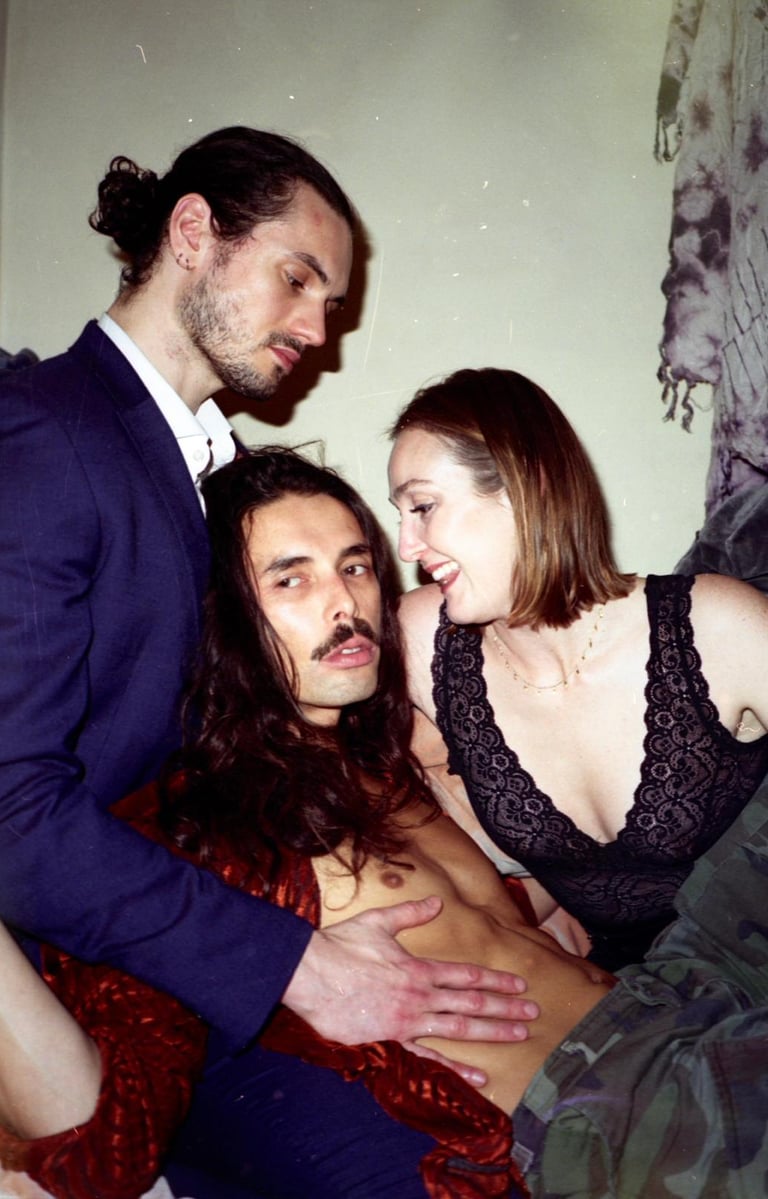
The stars of the show from left to right - Rowland Stirling (Tom/Jake), Dale Robertson (Alex), and Olive McHugh (Petunia)